
healthcare education blog
Click image to start the video
Countering online threats, including cyberbullying, requires active participation and support of all community stakeholders. Collaborative, safe learning environments, integrated digital literacy curriculums, and institution-wide effort leads to enhanced individual psychological resilience against threats, exploitation, and efforts of misinformation and disinformation.
Read More
Using effective classroom management to influence motivation and engagement in online learning.
Online learning presents challenges in maintaining student engagement and motivation, both of which are strongly linked to positive academic outcomes. Additionally, external factors (i.e. Internet outages) and internal factors (i.e. feeling isolated) can demotivate students. To address this, educators must intentionally design courses that are clear, practical, and contextually meaningful while balancing independence with collaborative engagement. The course needs reliable, user-friendly digital tools to ensure proper delivery. Effective classroom management, balanced cognitive load, thoughtful digital tool selection, and predictable communication collectively create an environment that promotes engagement, reduces demotivation, and supports strong academic outcomes.
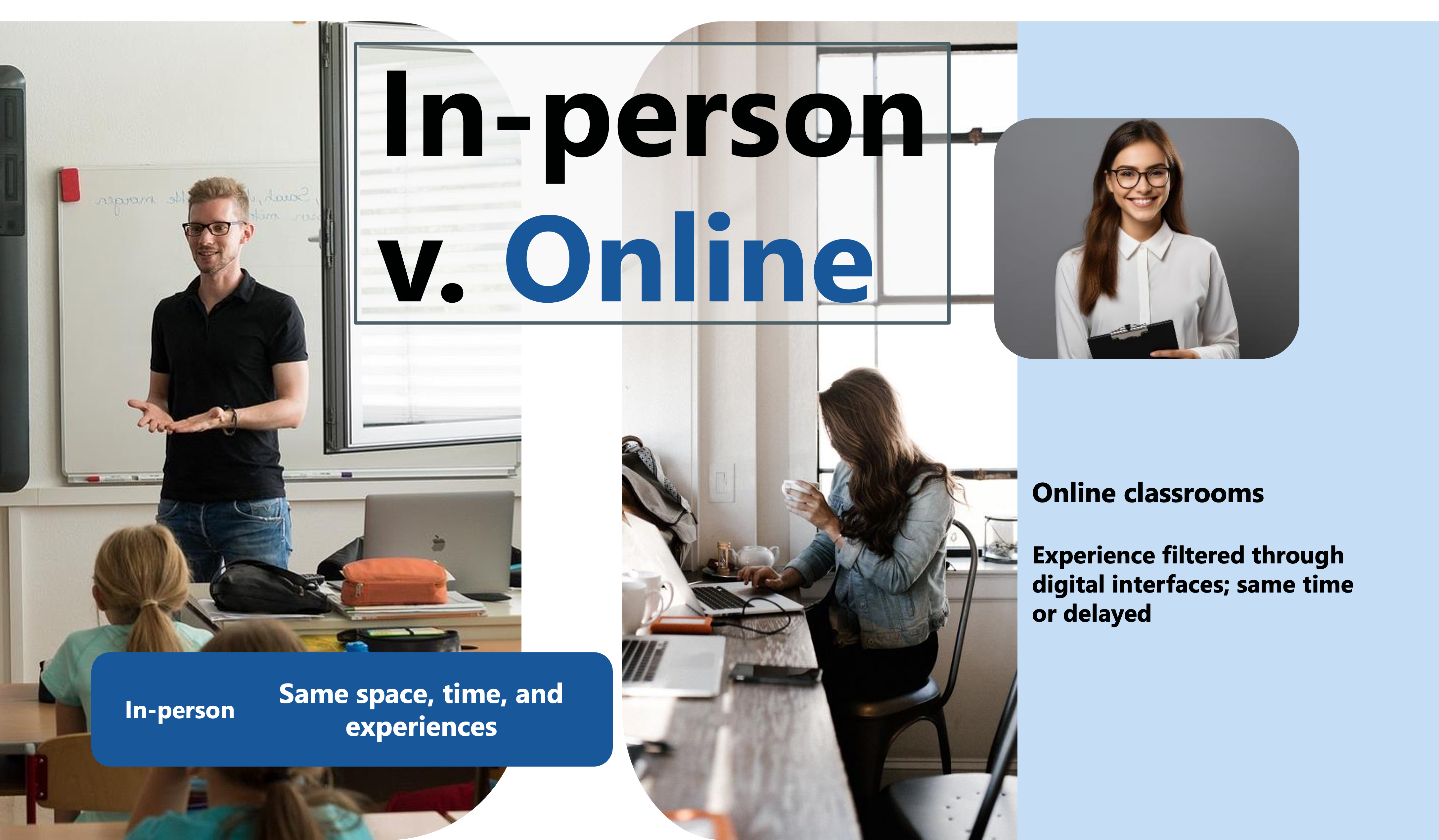
Online Classroom Management
Virtual learning environments require classroom management tools to foster effective learning just like in-person settings; they just get applied with a twist. While each environment has its own challenges for some students, proper classroom management approaches can provide an online learning experience on par with in-person. Intentional planning and design must ensure digital tools, policies, procedures, and classroom management strategies align to support student learning, effective communication, and a safe learning environment.
Read More

Modern, commercial off-the-shelf tools make course creation and content management easier. Google Classroom facilitates integrated file sharing, VTC platform, email, spreadsheet, and word processor applications which function like Office tools. Students receive reminders and time management support, and the suite of applications supports both synchronous and asynchronous content delivery.
Read More
Emerging technologies promise innovative and engaging healthcare training and medical education beyond what could be envisioned in the last century. Innovative adaptations poised to revolutionize professional and academic healthcare training leverage legacy technologies alongside artificial intelligence, big data, and include real-time translation support and using digital twins and virtual patient simulation.
Read More
Tools organic to Office 365 and Microsoft Teams create an exceptional digital foundation upon which online and remote training for healthcare providers can be built. Their flexibility supports high-volume, fast-paced organizations by creating an on-demand capability. Recorded sessions can be reviewed, transcribed for those preferring text over auditory learning, or translated for better understanding for non-English speaking and English as a Second Language (ESL) participants. However, when user access and proficiency deficits hinder content delivery, a web-based learning management system may be able to provide better support.
Read More